


.png)
After the Feed
Do you remember when your friendships translated for the first time? I was thirteen ranking my Top 8 shelf on MySpace, only to realize I didn't have eight friends I'd include and ranking them made my stomach sink.
Fast forward to 2026, and numbers are still the fastest way for a stranger to determine your status. The platform on which you've gained them adds context. Your name, profession, appearance all scrutinized in the flick of a scroll, quickly adding up to a first impression.
What's real or not is an afterthought. Perception is reality.
Early internet was a companion for many users, whether it was Tumblr communities or the early blogging world. It allows anyone to expand their network beyond geographies and gain the access that was held by gatekeepers.
When the algorithm became the discovery tool for default social experiences, it forced everyone into the same doomscroll. In doing so, it fundamentally changed how humans find connection online, creating parasocial relationships that optimized for the wrong metrics.
What if it wasn't the desire for human connection that broke — but the game itself?
The barrier just collapsed
With today’s agent functionality the cost of creating software has collapsed to nearly zero.
But a more interesting consequence of this is the friction AI removed.
Before, if you had an idea for an app specific to your community or context, you had two options: find an existing platform that approximated it, or hire someone to build it and hope they understood what you meant. Either way, building yourself was for a technical user. It involved real friction for an app most people might not want that badly.
That friction is effectively gone. Intent can now translate directly to action.
My brother-in-law recently built an app for his friends where they share weekly sports parlays. He vibe-coded it in a week, and now they use it every week. That wasn't possible 18 months ago.
We’ve moved from personal computers to personal software.
The parlay app will never have a million users, but it doesn't need to. By the metric that actually matters, does it deepen specific relationships, it is working perfectly.
The numbers confirm this is resonating
Apple app store submission grew 30% in 2025, followed by an 84% year over year jump in Q1 2026, the largest surge in a decade.
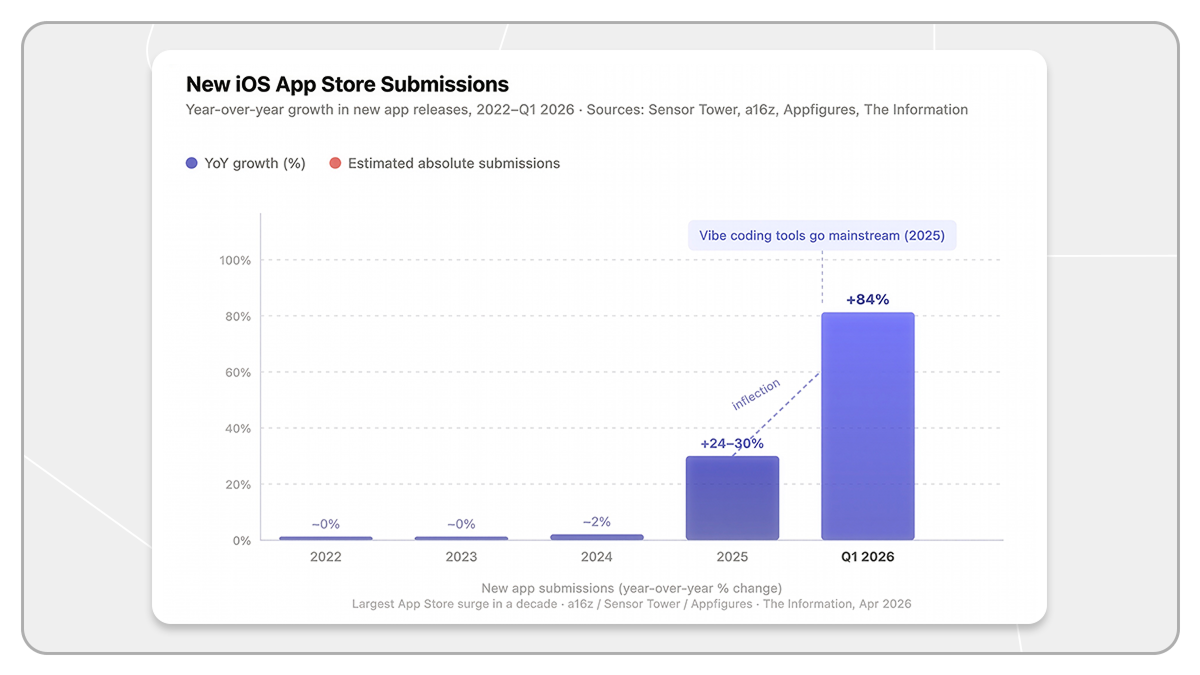
This after declining 48% from 2016 to 2024. The inflection point correlates precisely with the release of more accessible agentic coding tools.
What’s even crazier is 63% of vibe coding users today classify themselves as “non-developers,” many of whom have never written a line of code.
Personal social software is the future
When I think of the early web, I remember cozy corners where lifestyle blogs, independent journalism and the personal website proliferated. One of the biggest enablers of websites was an open source content management system called WordPress.
As of 2026, Wordpress powers nearly 44% of all websites published on the internet.
WordPress didn't succeed because any single blog had millions of readers. Most WordPress sites have relatively low traffic.
It succeeded because it enabled millions of distinct, self publishing experiences on shared infrastructure.
The metric that mattered was websites deployed. That's the frame for what's coming.
What would a world of thousands of social experiences, many of which are pop-ups, look like? Each built for a specific group, ritual, context or use case.
A weekly parlay app for eight friends. A darkroom photography community for a neighborhood. A shared reading log for a family. A group planning tool for a climbing crew.
None of these need to win the internet. All of them deepen specific relationships in ways that no generalized platform can, because no generalized platform was designed with those specific people in mind.
When software doesn’t need to scale it allows for personalization and community formation.
When the cost of building a social experience approaches zero, the bottleneck shifts from infrastructure to imagination.
Why AT Protocol is the infrastructure that makes this matter
The problem with building your own social experience from scratch is starting from zero. Your social graph lives somewhere else. Your identity lives somewhere else. You're effectively building on sand, where the ground can shift quickly under your feet.
This is what killed most of the 'build your own community' tools of the last decade. The only audience you’ve been able to own is your email list. Every new network asks users to start over - new account identity, new followers, new context. AT Protocol breaks this constraint.
When you build on AT Protocol, you're not building on top of a platform. You're building into a network that users already belong to. Their identity travels with them. Their followers travel with them. Their context travels with them. The parlay app isn't a closed garden but rather it's a node in a social graph that already exists.
This means a builder who creates something for eight friends doesn't have to solve the cold start problem. The network is already there. Someone discovers the parlay app and joins with their existing AT Protocol identity, their connections see they joined, context compounds across deployments rather than within each one.
What you get out of the box when you build on AT Protocol:
Shared identity on the AT protocol. Social graph portability - bring your users with you. Moderation primitives which allow you to focus on the product and not trust & safety tools. A whole suite of a la carte building blocks are coming.
The things that take months to build from scratch, AT Protocol gives you out of the box.
Attie, the feed-building tool the Bluesky team recently launched, is a live demonstration of what this infrastructure unlocks. It's a portal into creating your own feed experience on top of the underlying network. What you find there is a vibrant set of users already organizing events around science and academia, sports, news, analogy hobbies, and niche interests that you rarely see spaces made for. The like-minded people are already in the network. The tools to build for them are already available.
There are some really unique examples being built today.
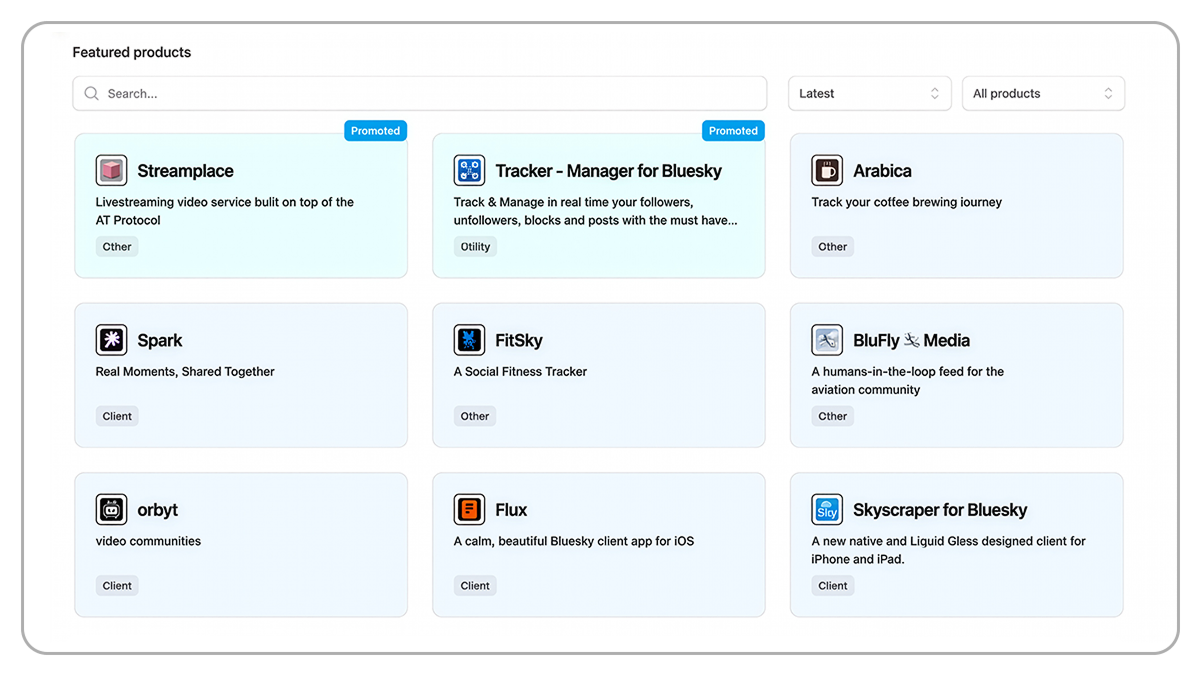
One of my personal favorites, Anisota, created a gamified social interface where each post becomes a collectible trading card with rarity ratings and stamina limits to discourage compulsive scrolling. It makes social feel like play. It's built on AT Protocol, which means it inherits the network rather than having to recruit it.
Tangled is another example, building a social coding platform where coding is a social, owned experience rather than a solitary professional one.
These aren't competitors to Bluesky. They're what a healthy protocol ecosystem looks like: multiple distinct experiences, all running on a shared identity and data layer, each finding the specific community it was built for.
The open question worth sitting with
The thing I keep coming back to: if AI makes creation cheap for everyone, doesn't everything converge toward the same AI-generated aesthetic? If the tools are the same, don't the outputs homogenize?
I don't think so. and here's why. The inputs to a 1-of-1 social experience are human taste, specific relationships, and local context. Those don't homogenize. The medium becomes generative but the intent stays personal. My brother's parlay app is shaped by the specific way his friend group talks about sports, the running jokes, the particular format of their picks. No amount of AI tooling makes someone else's version of that app feel like his.
The broader 'human-only' framing emerging across new social apps are responding to this desire to prioritize human connection. When synthetic content saturates the feed, genuine human context becomes the scarce resource. We are seeing this permeate our everyday interactions. Recently, World launched a “humans only” concert as a way to combat the challenge of bots sniping tickets online.
We’ve also seen this in our digital spaces, apps like retro or subtext, putting an emphasis on private social for humans only.
1-of-1 social is, among other things, a structural defense against that. It's social designed around specific people, which means it's legible to those people in a way that generic content can never be.
Build something
Cozy corners of the internet are coming back. Not as a nostalgic throwback but as a return to the fundamentals of what made the internet a meaningful place for connection. structural consequence of tools that make personal software possible.
The social graph can be open. The identity layer can be portable. The moderation primitives are available. The barrier isn't technical anymore. It's imagination.
Think about the ritual your group already has that no app serves quite as well. The shared behavior that happens in spite of the tools you're using, not because of them. The group chat that's doing work it was never designed for.
That's the brief. Build the thing that makes it better — and build it on infrastructure that means your users don't have to start from scratch to join you.
Get started at atproto.com/guides
Explore the Atmosphere ecosystem at atproto.com/ecosystem
Try Attie at https://attie.ai
The content provided herein may include information regarding past and/or present portfolio companies or investments managed by Blockchain Capital or its affiliates and are provided for illustrative purposes only. The views expressed in each blog post are the personal views of each author and do not necessarily reflect the views of Blockchain Capital and its affiliates. Neither Blockchain Capital nor the author guarantees the accuracy, adequacy or completeness of information provided in each blog post. No representation or warranty, express or implied, is made or given by or on behalf of Blockchain Capital, the author or any other person as to the accuracy and completeness or fairness of the information contained in any blog post and no responsibility or liability is accepted for any such information. Nothing contained in each blog post constitutes investment, regulatory, legal, compliance or tax or other advice nor is it to be relied on in making an investment decision. Blog posts should not be viewed as current or past recommendations or solicitations of an offer to buy or sell any securities or to adopt any investment strategy. The blog posts may contain projections or other forward-looking statements, which are based on beliefs, assumptions and expectations that may change as a result of many possible events or factors. If a change occurs, actual results may vary materially from those expressed in the forward-looking statements. All forward-looking statements speak only as of the date such statements are made, and neither Blockchain Capital nor the author assumes any duty to update such statements except as required by law. To the extent that any documents, presentations or other materials produced, published or otherwise distributed by Blockchain Capital are referenced in any blog post, such materials should be read with careful attention to any disclaimers provided therein.





.png)
.png)

.png)
.png)
No Results Found.