


The Crabification of Capitalism
The Crabification of Capitalism
“All of these companies are beginning to look the same. Sure, you had different starting points, but eventually everyone has cards, yield, trading, and credit,” lamented a stablecoin founder over drinks.
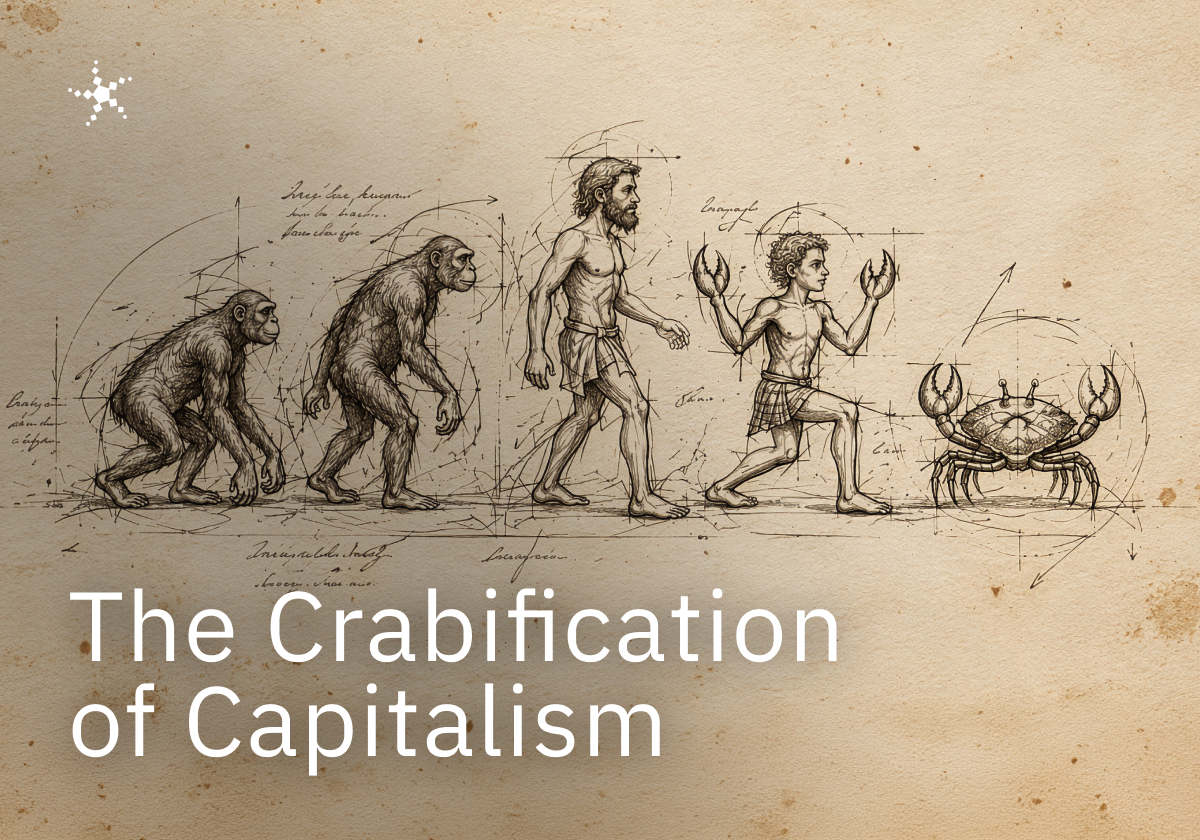
“It’s crabification!” I joked.
I remember learning about this as a kid. There’s a quirk in evolution where different crustaceans keep becoming crabs. The technical term is carcinization. You’d look at crabs and assume they all inherited the shape from the same ancestor, but the crab shape has evolved independently again and again. From nature’s perspective, there seems to be an advantage to having a wide, flat shell and tucking your tail underneath it.

Source: EurekAlert
I think capitalism favors a couple of company shapes too. As a result, we’re seeing companies that started in very different places end up looking alike, especially in fintech and AI.
Fintech’s crab: the financial superapp
Everywhere you look in fintech, someone seems to be building a superapp that combines a bank and a brokerage. You can hold a balance, spend, earn, borrow, and trade. A company might start with just one of those, but once it has users and their balances, there are all these adjacent products it can stitch on.
Robinhood is the obvious example. It started with commission-free stock trading and later added crypto, retirement accounts, yield on cash, a credit card, and now banking. Coinbase started with crypto trading and now offers equities trading alongside crypto, derivatives, and other products. Phantom started as a Solana wallet and now offers perps, tokenized stocks, cash, and a card. There are a ton of other examples.
This company shape is not new in financial services. Merrill Lynch launched a Cash Management Account in 1977, which combined a brokerage margin account, a money-market sweep, and a debit card.
Getting someone to trust your app with their money is the hard part. Once they do, adding more products can improve the economics of the entire platform. Your revenue per user rises, while the cost of acquiring them falls because you can acquire a user through one product and cross-sell them into others. Additionally, every product you do not offer gives a competitor a wedge to enter the relationship and eventually become the user’s primary financial provider.
AI’s crab: the vertical AI company
Frontier AI is beginning to look the same as well. Frontier labs, cloud providers, and AI app businesses are all moving toward some version of “model plus cloud plus harness.”
OpenAI obviously started developing frontier models, and later built ChatGPT as a means of productizing them. It is now also deeply involved in securing the infrastructure needed to run them (see Stargate and its custom chip program with Broadcom).
Nvidia is coming from the other direction. The company sells chips, but it also operates DGX Cloud, develops Nemotron models, and supplies software to serve them.
Another example: Amazon has cloud infrastructure and enterprise distribution. It has now added custom silicon, its own Nova models, and Bedrock, where customers can use models and build agents. Google has a similar combination, in addition to Gemini.
Of course, Nvidia doesn’t suddenly have Google’s advertising business, and signing a compute agreement doesn’t make OpenAI a general-purpose cloud provider. But each is building toward a future where it has reliable access to compute, capable models, and software that puts those models to work under one metaphorical roof. This is a classic vertical integration strategy.
If you don’t control a layer, it becomes a place where a supplier can raise prices, or even directly compete with you. Every company in the stack faces these same pressures, so wherever it starts, it has a reason to expand into the layers next to it until it owns some version of all of them.
There are technical benefits too. A company that understands the model, chip, and software serving it can improve them together. An improvement that looks small at one layer can matter a lot when you are running it across an enormous fleet.
Does this mean there’s only room for one crab?
Just because a lot of companies look the same doesn’t mean they’ll all compete until there’s only one left standing. Just like we have blue crabs and king crabs, companies can specialize. One fintech might focus on the Global South, another on affluent customers in the Americas, another on Europe. Banks already do this. They offer similar products, but knowing the customer, navigating local regulation, and earning trust still matter. AI is a different story. There are reasons to expect specialization in consumer versus enterprise, or niche versus general-purpose settings, and so on.
These fintech and AI combinations seem to work well enough that companies keep arriving at them from different places. I think that’s a reason to take the business model seriously. Whether a particular company can make it work is still a separate question.
If you’re building one of these companies, I wouldn’t be too worried that others are adding the same products. I’d be more interested in who you’re building for and why they’ll choose you.

The content provided herein may include information regarding past and/or present portfolio companies or investments managed by Blockchain Capital or its affiliates and are provided for illustrative purposes only. The views expressed in each blog post are the personal views of each author and do not necessarily reflect the views of Blockchain Capital and its affiliates. Neither Blockchain Capital nor the author guarantees the accuracy, adequacy or completeness of information provided in each blog post. No representation or warranty, express or implied, is made or given by or on behalf of Blockchain Capital, the author or any other person as to the accuracy and completeness or fairness of the information contained in any blog post and no responsibility or liability is accepted for any such information. Nothing contained in each blog post constitutes investment, regulatory, legal, compliance or tax or other advice nor is it to be relied on in making an investment decision. Blog posts should not be viewed as current or past recommendations or solicitations of an offer to buy or sell any securities or to adopt any investment strategy. The blog posts may contain projections or other forward-looking statements, which are based on beliefs, assumptions and expectations that may change as a result of many possible events or factors. If a change occurs, actual results may vary materially from those expressed in the forward-looking statements. All forward-looking statements speak only as of the date such statements are made, and neither Blockchain Capital nor the author assumes any duty to update such statements except as required by law. To the extent that any documents, presentations or other materials produced, published or otherwise distributed by Blockchain Capital are referenced in any blog post, such materials should be read with careful attention to any disclaimers provided therein.











No Results Found.