


.png)
What Happened to Conferences?
People are becoming quietly disillusioned with the mega crypto conferences. Investors and founders I know who used to spend half their year on the circuit are skipping cities they wouldn't have missed two years ago. Declining ROI and lower signal are the most common complaints, but those don’t explain the root cause. So what's going on?
Why Conferences Mattered
Most industries are local before they go global, like software in the Bay Area or finance in New York and London. But crypto started global from day one. There was never a natural reason for a founder in Lagos and an investor in Singapore to end up in the same room. But since business gets done faster in person than over Zoom, in-person work was still necessary. Crypto never had a city, so conferences became the workaround.
Cynical view: Conferences Got Unbundled
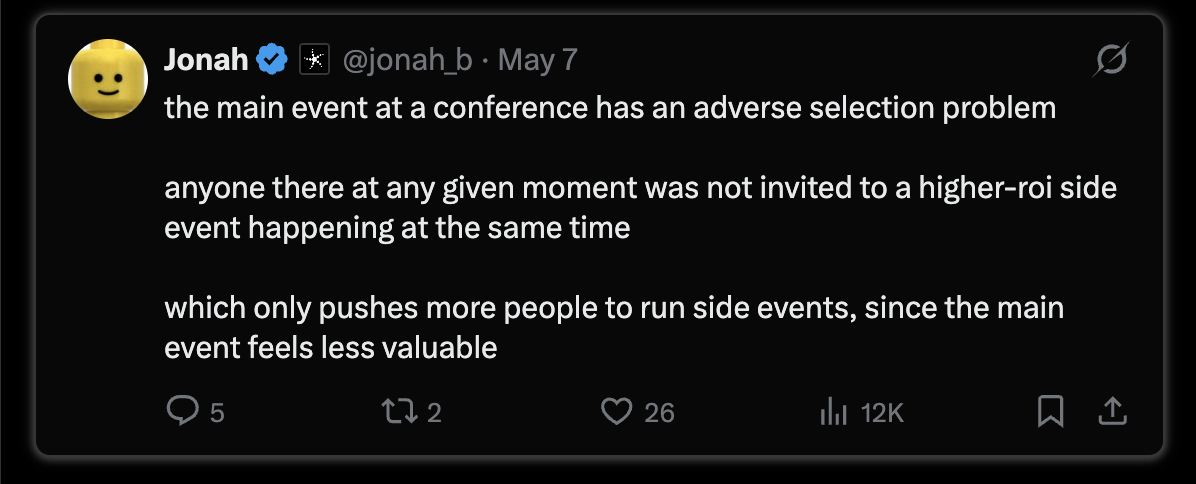
I noticed the problem at my first crypto conference. I had a main-event lanyard and kept declining invitations to side events because, in my head, the main event was what I'd paid for. A friend eventually talked me into going to a side event at some random cafe. Then another. By Wednesday I'd figured out that the side events were where the high-quality builders and investors had migrated. Being at the main event was adverse selection: you hadn't been invited to something better. The content wasn't a reason to be there either. The same dozen speakers had said everything on X months ago.
The rest of the industry came to this conclusion too. In response, the main event became just the official excuse for everyone to be in the same city. Now the week is filled with ten parallel side events per hour, with people cabbing between them.
One popular format that came out of this is the sub-twenty-person curated dinner. But these dinners miss out on the serendipity of conferences. Some of the most consequential relationships I've built in this industry are with people I had no reason to know existed. A handful of our portfolio companies came from chance encounters at events. Curated dinners may be “higher signal,” but big conferences sample from a population the dinner cannot reach.
The straw that broke the camel's back, for a lot of folks, came at one of those dinners. You looked around and realized the people at the table were mostly from your home city. The handful you didn't recognize were coming through next month anyway. You flew across the world to spend the evening with people you already knew, or were about to meet at home. Part of this is because crypto talent is beginning to centralize around NY and a few other cities.
Another format has also been gaining popularity: the invite-only, exclusive conference. Curated enough that everyone in the room is worth meeting, but big enough to preserve some serendipity. The trade-off is that gatekeeping cuts against crypto's early meritocratic ethos: when the room is assembled by reputation, new talent has a much harder time breaking in. Still, some of these events remain high signal, and I expect the format to keep growing.
Between the unbundling into side events and the growth of who's-who conferences, the "Giant Conference" starts to break. It's a network-effect good. The reason to fly to Singapore is that everyone else is flying to Singapore. That flywheel runs both ways. When ROI drops for the highest-signal people, they stop going, which makes the room worse for everyone else. And soon others stop going too.
This dynamic isn't unique to crypto. People are saying the same thing about SF events now that AI has gone mainstream: the private rooms are where the high signal happens. It's a basic party dynamic: once word gets out that one is good, the crowd that made it good moves on to a smaller one.
Optimistic view: The Outward Turn
On the surface this looks sad. Are the big crypto events dying? I think the opposite. Crypto is diffusing into the rest of the economy. There are fewer crypto conferences because an hour teaching a fintech how stablecoins work pays off more than an hour preaching to the choir. Many people skipping conferences are spending their time with the audience that doesn't yet use crypto.
And the best companies in crypto are all turning outward. Stablecoins have penetrated normal finance faster than anyone could forecast a few years ago. Neobanks built on crypto rails are focused on non-crypto customers. HyperliquidX is shipping oil futures, and Polymarket offers election and macro hedging.
Traditional finance conferences now have stablecoin tracks and prediction market panels. "Crypto conferences" may go the way of "internet conferences," a label that disappeared once every conference became one.
What Will Happen to the Mega Crypto Conferences?
My guess is we end up with fewer blowout crypto conferences a year, not the treadmill of one every eight weeks. It made sense when crypto was inward facing, but we're past that now. The industry doesn't need to remind itself it exists every two months. The real work is in the rest of the economy. And this story isn't new. As an industry grows and the crowd floods in, the signal gets drowned out and retreats to private rooms. That's the price of going mainstream: for better or worse, it's what winning looks like.Thank you Kinjal and others at Bcap for the feedback on this article.
The content provided herein may include information regarding past and/or present portfolio companies or investments managed by Blockchain Capital or its affiliates and are provided for illustrative purposes only. The views expressed in each blog post are the personal views of each author and do not necessarily reflect the views of Blockchain Capital and its affiliates. Neither Blockchain Capital nor the author guarantees the accuracy, adequacy or completeness of information provided in each blog post. No representation or warranty, express or implied, is made or given by or on behalf of Blockchain Capital, the author or any other person as to the accuracy and completeness or fairness of the information contained in any blog post and no responsibility or liability is accepted for any such information. Nothing contained in each blog post constitutes investment, regulatory, legal, compliance or tax or other advice nor is it to be relied on in making an investment decision. Blog posts should not be viewed as current or past recommendations or solicitations of an offer to buy or sell any securities or to adopt any investment strategy. The blog posts may contain projections or other forward-looking statements, which are based on beliefs, assumptions and expectations that may change as a result of many possible events or factors. If a change occurs, actual results may vary materially from those expressed in the forward-looking statements. All forward-looking statements speak only as of the date such statements are made, and neither Blockchain Capital nor the author assumes any duty to update such statements except as required by law. To the extent that any documents, presentations or other materials produced, published or otherwise distributed by Blockchain Capital are referenced in any blog post, such materials should be read with careful attention to any disclaimers provided therein.







.png)

.png)

.png)
No Results Found.