


The Financial Container
Tokens will do for capital markets what containers did for global trade.
Finance has a very expensive packaging problem. Every asset comes in its own wrapper and lives in its own operating system: a mortgage is a collection of contracts, PDFs, databases, and servicing relationships. A private fund interest is a subscription agreement and a row on a transfer agent’s spreadsheet. A share of stock lives across a chain of broker, custodian, and depository records. The list goes on.
When assets move between institutional boundaries, they often have to be unpacked, verified, reconciled, and repacked into the receiving institution’s systems. Much of this work exists only because institutions maintain different representations of the same underlying assets and claims. At global scale, that fragmentation places an enormous hidden cost on society: nearly $1.8 quadrillion of assets sits on the world’s balance sheets, yet much of it still can’t move freely between institutions without bespoke operational work. That friction slows the rate at which capital can be redeployed into new businesses, infrastructure, housing, and other productive uses.
Tokenization attacks this problem at its root. A token gives an asset or financial claim a standard, machine-readable interface. Once assets can be recognized and used on shared networks, exchanges, lenders, custodians, servicers, and software applications can interact with them without rebuilding the financial stack each time. The result is a path toward capital markets that operate on common, programmable rails, where assets can move, settle, and be put to work with far less friction.
The best analogy for how tokenization will change the world is containerization.
Containerization enabled the modern global supply chain
Before the 1960s, cargo moved in many different forms. Coffee traveled in sacks, machinery in crates, cotton in bales, and oil in barrels. Every commodity had its own handling requirements, so every ship had to be loaded and unloaded by hand. Skilled longshoremen developed an art around this work. They packed ships densely, distributed weight, and secured cargo so that it didn’t shift and break at sea. This craft existed purely because the system lacked a standard package. The result was that ships often spent more time sitting in port than at sea, and break-bulk cargo was repeatedly handled, counted, damaged, lost, and stolen as it moved between ships, trains, trucks, and warehouses.
In 1956, a North Carolina trucking entrepreneur named Malcom McLean sailed a converted tanker called the Ideal-X from Port Newark to Houston carrying 58 detachable trailer bodies. On arrival, trucks picked them up without ever opening them. The Ideal-X loaded at $0.16 per ton, which was roughly 36 times cheaper than break-bulk. This marked the birth of the modern shipping container.
Over the next two decades, the dimensions, fittings, and load requirements of containers standardized, and the entire supply chain reorganized around the box, each function now able to specialize. Ships were built with vertical cells so containers could be stacked safely. Cranes were engineered for predictable, high-speed lifts. Truck chassis and railcars were designed around matching dimensions and attachment points. And ports became enormous machines for moving standardized containers between specialized forms of transportation.
The first-order impact was a massive decrease in transport costs in both time and money. Australia-Europe transit fell from 70 days to 34, and vessel capacity quadrupled. This allowed trade to shift toward manufactured and intermediate goods, and firms began to fragment production across countries, while new logistics companies emerged to coordinate increasingly complex global networks as supply chains rapidly expanded.
The second-order impact was a massive increase in economic activity. The World Bank estimates bilateral trade between developed countries rose 1,240% in the fifteen years after both partners adopted containers. Through containerization and the infrastructure reorganization it enabled, global supply chains were able to scale and the world’s economic development accelerated in a big way.
Tokens are financial containers
A token is a container for a financial claim. Instead of cargo, it carries economic rights and operating state: who owns the asset, how it can move, what cash flows it produces, what permissions apply to it, and how software is allowed to interact with it.
Once an asset has a machine-readable interface, an exchange can make it tradeable, a lending market can finance it, a custodian can hold it, and a wallet can route its cash flows. Software applications can recognize the asset and apply rules to it without negotiating a new integration with every institution involved. This is what makes tokenization different from simply digitizing a document or adding another database: participants can rely on the token as the asset’s shared operating interface. This turns out to be extremely powerful when the effects compound across an ecosystem.
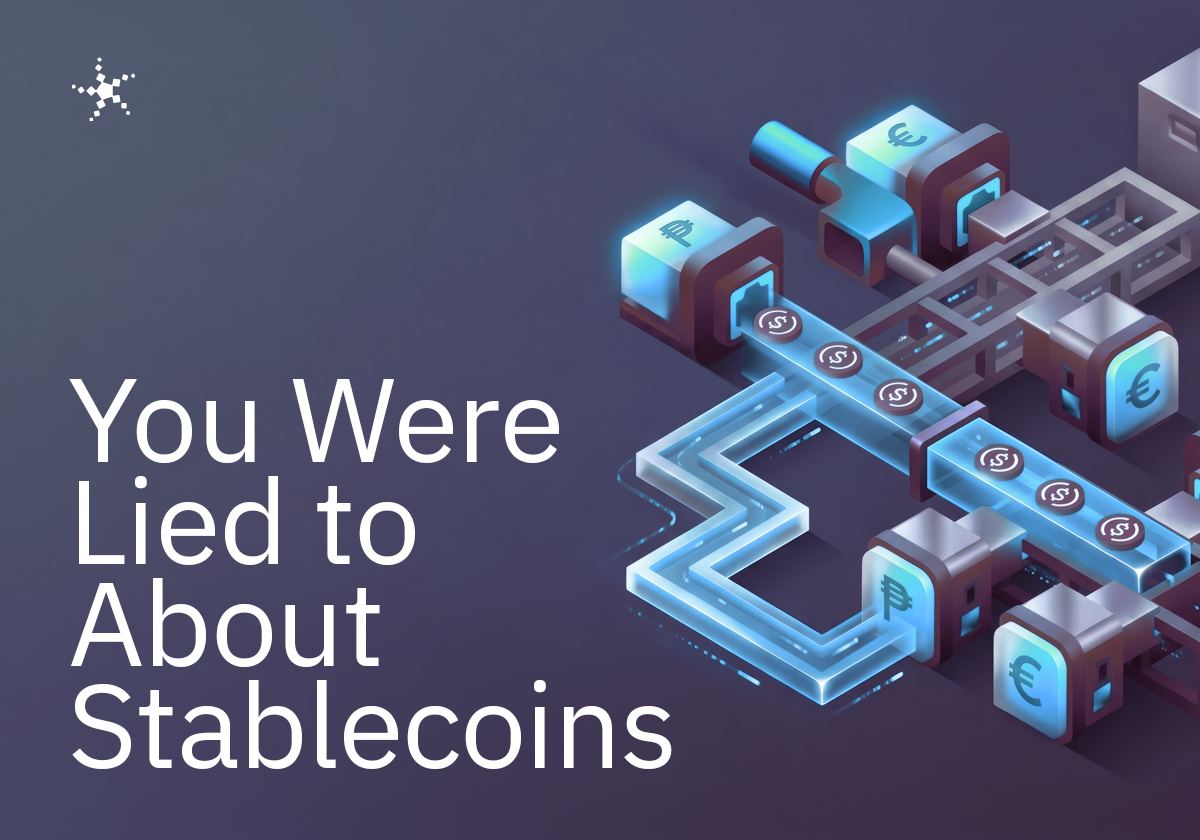
Stablecoins offer the clearest example of tokenization’s potential. While international wires generally take days to move dollars through the correspondent banking system, stablecoins move around the world in seconds, at near-zero cost. This works because stablecoins are accepted by a network of exchanges, custodians, on/off ramps, payment processors, and wallets around the world that recognize the token interface. These are the new financial ports, cranes, trucks, trains, and ships, and they move value in tokens. Much of this infrastructure was originally built to support Bitcoin and Ethereum, but once it existed, stablecoins and other tokens could travel through it too. Stablecoin activity then attracted more users, liquidity, applications, and infrastructure, making the network more valuable for the tokens that followed.
The results speak for themselves: there’s $300B of stablecoins in circulation, and they facilitate Visa-scale volume with roughly 10x the velocity of M1/M2. Cross-border payment costs have fallen by an order of magnitude, and hundreds of millions of people around the world have gained reliable access to dollars and payment rails. The network has arguably proven its worth for dollars and delivered far better cost, speed, and reach, resulting in an order-of-magnitude increase in economic activity per dollar.
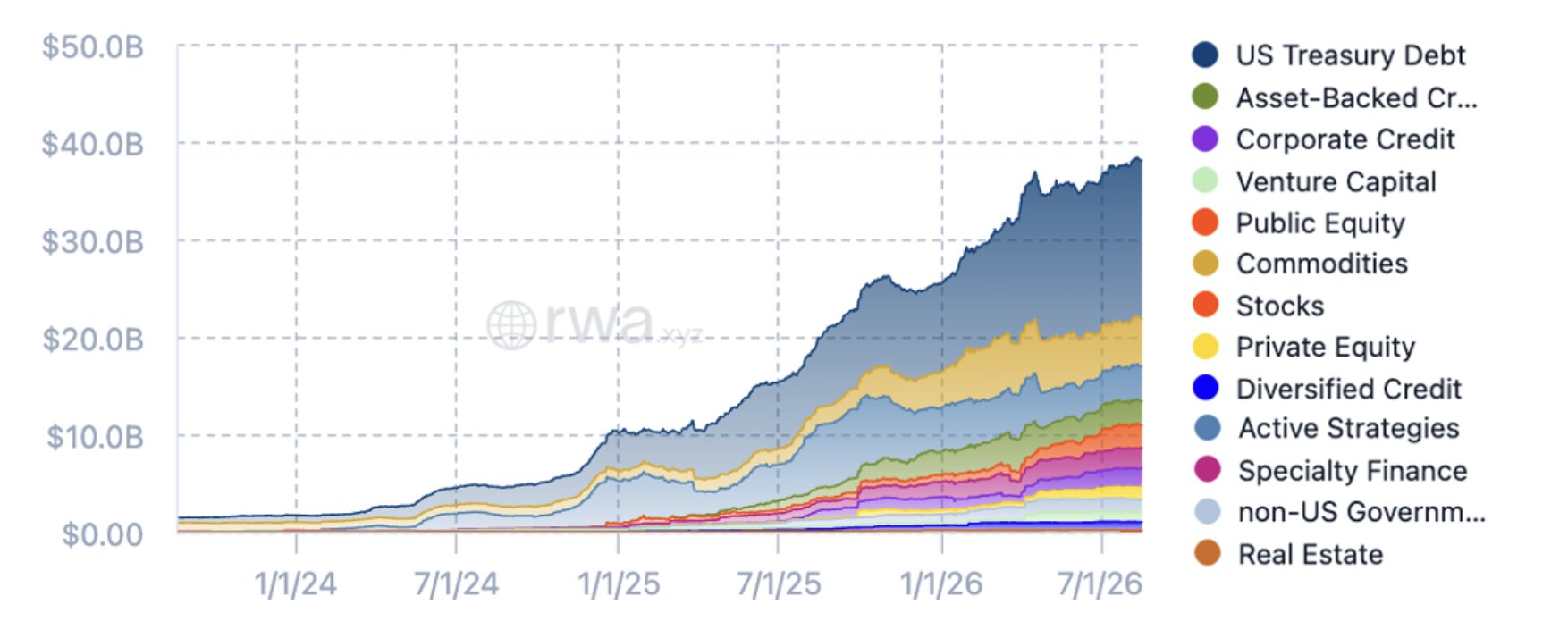
And now, that pool of highly active dollars is attracting other assets that seek stablecoin deposits. Today there’s nearly $40B, up about 10x from two years ago, and growth is accelerating. This is driven by Treasuries, money market funds, commodities, private credit, equities, and fund interests across hundreds of issuers.
The natural next step is for the plumbing to come onchain as well. Our portfolio company Tare, for instance, is bringing origination, servicing, and securitization of credit assets onchain, leveraging the ability of tokens to carry with them the servicing history of all underlying loans. This allows Tare to replace the expensive, highly intermediated lending value chain with a thin software layer and transparent marketplace where lenders and borrowers share a universal ledger of tokenized loans. This lowers the cost of lending while making the loans easy to integrate as collateral across the network, increasing the gravitational pull of tokenization.
Every asset class has a similarly shaped opportunity, and as the infrastructure gets built out, the network effect grows and attracts more liquidity, users, infrastructure, and applications. This will cause the growth of tokenized assets to accelerate from here.
Capital markets will reorganize around tokens
Just as global supply chains reorganized around the container, global capital markets will reorganize around tokens.
The shape of this is already visible in DeFi. Another of our portfolio companies, Aave, allows holders of eligible tokens to post them as collateral and draw credit from a market of lenders at floating rates. The protocol contains the rules, and eligibility is determined at the asset level. This is a departure from the market structure of traditional lending. To borrow against an asset today, a person or business typically begins with an institution. The institution controls access, evaluates the borrower through its own process, and offers products through its own network. The financial capability is attached to the institutional relationship.
On Aave, the gating requirement is the asset itself. Smart contracts recognize the token, apply transparent rules, and connect it to a market for capital. This inverts the relationship between asset holders and financial services: capabilities attach to the asset, not the owner’s institutional relationships.
Put differently, tokens make assets executable, like software. Once an asset exists in a form a public network can recognize, applications can compete to add capabilities to it. An exchange can make it tradeable, a lending market can finance it, a wallet can route its cash flows, and so on. The issuer brings the asset onchain once rather than building a separate system for every use case.
This changes the architecture of financial institutions. Banks, brokerages, and asset managers currently bundle custody, underwriting, liquidity, servicing, compliance, and distribution inside closed products. Crypto networks allow those functions to separate and specialize. One institution can originate and service a loan, while others can fund it, price its risk, trade it, insure it, or build applications that use it. The asset can move between modular services through a common interface rather than being rebuilt inside each provider’s system.
The scale advantage therefore shifts from the institution to the network. In legacy finance, large institutions support more products because they can absorb the fixed cost of infrastructure for each asset and customer segment. On public crypto networks, on the other hand, much of that infrastructure is shared. New providers can reach assets, capital, and users without rebuilding the ledger, exchange, custody, and settlement systems, making the network simultaneously an easier and cheaper stack to build on.
The network effects have already hit escape velocity with stablecoins, and as a result, capital markets will increasingly reorganize as open networks of specialized services built around tokenized assets. In this next paradigm, institutions will compete on the quality of the capital, underwriting, risk management, servicing, and distribution they provide, not on their ability to own the database or control the customer’s only doorway to the market.
The world’s balance sheet will come onchain
The most important consequence of this shift is the creation of a universal market for capital.
Today, capital markets are bottlenecked by institutions. Most people and businesses don’t access capital markets directly; they access the narrow menu offered by the institutions willing and able to serve them. Those institutions determine which customers, geographies, asset classes, and transaction sizes they support.
Investors face the same constraint in reverse. They don’t have access to the world’s assets. They have access to the assets that institutions have chosen to underwrite, package, integrate, and distribute.
As a result, much of the world’s economic value is unreachable by today’s capital markets. Small receivables, local infrastructure, private businesses, emerging-market credit, and unconventional cash flows may be economically valuable, yet too fragmented, unfamiliar, or geographically distant to justify the expensive machinery that the legacy system required to finance them. The opportunity may be attractive and the capital may exist, but the network between them doesn’t.
Tokenization changes this by giving assets a standard interface through which they can become discoverable on global rails. As the financial system reorganizes around this new interface, the cost of participation drops dramatically for everyone. Finance becomes a native capability of software, which increases the capacity of the application layer to specialize within niche asset classes and geographies, and lets markets reach where they couldn’t before. Business applications that didn’t traditionally have access to sophisticated financial services will be able to easily incorporate payments, working capital financing, collateral management, and treasury functions within their stack, allowing many of today’s idle or “dark” assets to connect to onchain capital markets. To be clear, tokenization won’t magically make unfinanceable assets financeable, but it will eventually allow many quality assets that are structurally disconnected today to participate in markets.
And AI will amplify this shift by helping with operational requirements. AI agents will help evaluate assets, price risk, allocate capital, manage collateral, and settle transactions across this global, efficient, machine-readable market, thus further lowering the costs of delivering financial services. Through a combination of AI and crypto rails, markets that are currently bespoke and episodic stand to become continuous, global, and increasingly automatic, creating far more opportunities around the world and unshackling capital from institutional silos.
Capital allocation is one of civilization’s most powerful steering mechanisms. It determines which businesses expand, which technologies reach scale, which homes and factories get built, and which regions develop. Assets that are too small, local, bespoke, or operationally expensive for today’s financial system can become worth underwriting when the cost of reaching, financing, and servicing them collapses.
This was the deeper consequence of containerization. The container made entirely new patterns of trade and production economically possible. Goods could be produced where they were cheapest, assembled somewhere else, and sold around the world because the cost of coordinating the network had collapsed.
Tokens can do the same for capital. Over the next few decades, the world’s balance sheet will be able to evolve from a collection of isolated records into a market that software can navigate, allowing capital to flow according to merit instead of simply who controls the pipes. If stablecoins are any indication, this could enable the world’s capital markets to grow immensely and reach into places they’ve never been able to before.
The content provided herein may include information regarding past and/or present portfolio companies or investments managed by Blockchain Capital or its affiliates and are provided for illustrative purposes only. The views expressed in each blog post are the personal views of each author and do not necessarily reflect the views of Blockchain Capital and its affiliates. Neither Blockchain Capital nor the author guarantees the accuracy, adequacy or completeness of information provided in each blog post. No representation or warranty, express or implied, is made or given by or on behalf of Blockchain Capital, the author or any other person as to the accuracy and completeness or fairness of the information contained in any blog post and no responsibility or liability is accepted for any such information. Nothing contained in each blog post constitutes investment, regulatory, legal, compliance or tax or other advice nor is it to be relied on in making an investment decision. Blog posts should not be viewed as current or past recommendations or solicitations of an offer to buy or sell any securities or to adopt any investment strategy. The blog posts may contain projections or other forward-looking statements, which are based on beliefs, assumptions and expectations that may change as a result of many possible events or factors. If a change occurs, actual results may vary materially from those expressed in the forward-looking statements. All forward-looking statements speak only as of the date such statements are made, and neither Blockchain Capital nor the author assumes any duty to update such statements except as required by law. To the extent that any documents, presentations or other materials produced, published or otherwise distributed by Blockchain Capital are referenced in any blog post, such materials should be read with careful attention to any disclaimers provided therein.



.png)
.png)

.png)

.png)
No Results Found.